Amateur Satellites for Beginners: Working the Birds With a Handheld
You can work amateur satellites with a five-watt handheld and a homemade antenna. Here is exactly how, from tracking software to your first contact.
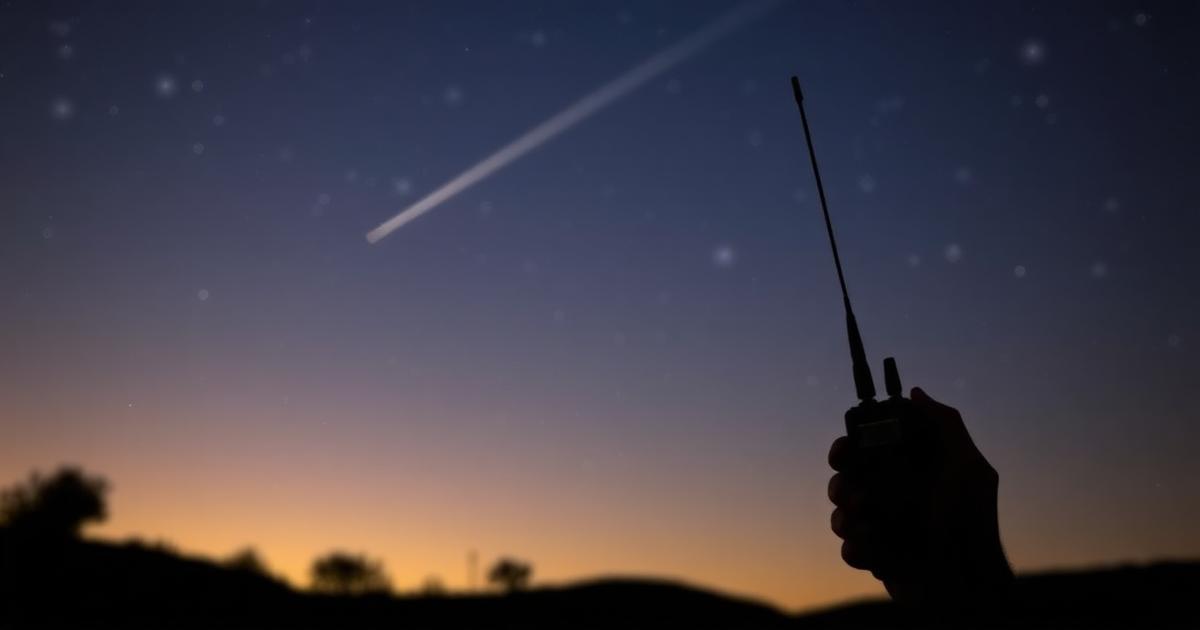
The best-kept secret in amateur radio
For less than the price of a dinner out, you can put your voice on a spacecraft. The amateur satellite fleet includes several linear transponders and FM repeaters that are open, active, and reachable with equipment you almost certainly already own or can build in an afternoon. There is no license upgrade required beyond a Technician-class in the United States. There is no special training, no membership fee, no permission to ask. If you can hit a local repeater, you can work a satellite. Almost every ham who tries it becomes an evangelist within a week.
The reason satellites feel exotic is that they were exotic once. In the 1970s and 1980s, working an amateur satellite required a fixed steerable antenna array on a rotor. Modern low earth orbit birds, especially the FM transponders like SO-50 and AO-91, are strong enough to work with a hand-aimed Yagi and a five-watt handheld. The whole setup fits in a backpack.
Two flavors of satellite
FM satellites act like a repeater in the sky. You transmit on one frequency, they retransmit on another, and only one contact happens at a time. Etiquette is strict because a pass lasts eight to fifteen minutes and dozens of operators want in. Linear transponder satellites accept a range of frequencies simultaneously, translate them to a different band, and let multiple SSB or CW conversations happen at once. They are quieter, less crowded, and require full duplex operation, which is harder but more rewarding.
For your first pass, start with an FM satellite. The gear is simpler, the exchanges are short by necessity, and success or failure is instantly obvious.
What you need to get on the air
A dual-band handheld capable of transmitting on 2 meters and receiving on 70 centimeters simultaneously, or vice versa, depending on the satellite. Almost any modern HT works. A homemade Arrow-style dual-band Yagi, which is a broomstick with three or four elements on each band. Free tracking software or a phone app that tells you when the satellite is above the horizon and what direction to point. A pair of headphones so you can hear yourself in the downlink and confirm you are getting into the bird.
That is the whole kit. If you are shopping, a commercial Arrow antenna runs about a hundred dollars and is worth it for the mechanical quality. A homemade version from copper plumbing pipe and a wooden dowel is about ten dollars and works just as well.
Doppler, in one paragraph
The satellite is moving toward you at the start of the pass and away from you at the end. The frequencies you hear and the frequency the satellite hears from you both shift by up to about 10 kilohertz over the pass. For FM satellites, this means you must retune the receive frequency in three or four steps as the satellite crosses the sky. Cheap radios with memory channels handle this well; you program the same satellite five times with slightly different frequencies and step through them.
For linear satellites, both sides of the transponder shift, and you must tune your transmit frequency as well as your receive frequency. This is why full duplex matters: you have to hear yourself to keep your uplink centered.
The first pass, step by step
Pick a bright pass, at least 30 degrees maximum elevation, in the morning or evening when signals are strongest. Set up your radio and antenna outdoors, away from buildings and metal. Point the antenna at the horizon in the direction the satellite will rise. Listen for the downlink. When you hear a QSO complete, key up briefly with your call sign and grid square. That is the entire exchange. Log it, thank the operator on the next pass, and enjoy the rest of the day knowing your voice just bounced off a spacecraft.
What comes next
Once you have a few FM contacts, try a linear pass with an SSB radio. Explore the ISS packet system, which digipeats packet radio through the space station. Try the amateur satellite ARISS school contacts if you have kids. Aim for the low earth orbit CubeSats, then work your way up to the higher orbit birds that give longer passes and easier operating. There is a lifetime of hobby in this corner of the spectrum and almost no one else is there. Every pass you work is a small reminder that amateur radio, done well, is one of the most inexpensive ways to touch space that a private citizen will ever have.
Every HAMSTATION tool runs entirely client-side. No accounts, no tracking, no server storage.
Open the toolkit →