Choosing Your First HF Antenna: Dipole, Vertical, or End-Fed
The antenna decides how far you get heard, not the radio. Here is an honest comparison of the three designs almost every new HF operator chooses between.
The antenna matters more than the radio
If you hand an experienced operator a thirty-year-old transceiver and a well-built antenna at a good height, they will work the world. Hand them the newest radio on the market connected to a compromised antenna stuffed against a metal roof, and they will struggle to hold a conversation across a state line. This is not a matter of taste or tradition. It is arithmetic. A modern receiver is already better than the noise environment it operates in, so improving it changes almost nothing. An antenna, on the other hand, controls how much of your transmitted power leaves the property and in which direction, and it controls how much signal the receiver has to work with in the first place. Antenna improvements of six or ten decibels are routine. Radio improvements of six or ten decibels do not exist.
The practical consequence for a new HF operator is that the money and effort ratio should be inverted from what most people assume. Spend modestly on the transceiver, buy good coax, and put real thought and labor into the antenna and its supports. A used hundred-watt radio and a carefully installed wire will outperform a flagship rig hanging off a compromise every single time.
The half-wave dipole, still the reference
The half-wave dipole is the antenna every other design gets compared to, and for good reason. It is two quarter-wave legs fed in the middle, it needs no ground system, it presents somewhere between thirty-five and ninety ohms depending on height, and it radiates broadside to the wire with a gentle pattern that covers most of the sky at useful angles. You can build one for a single band in an afternoon out of speaker wire, two insulators, and a coil of coax, and it will be the most honest antenna you ever own.
The dipole's cost is real estate. On 40 meters a half-wave is about 66 feet of horizontal span, and on 80 meters it is closer to 130. You also need two supports and a way to keep the center from sagging into the feedline. If you can find two trees, a roofline and a mast, or one mast and a fence corner for a sloping installation, you have enough. Use the HAMSTATION antenna length calculator to get your starting dimensions, then cut a few percent long and trim with an analyzer, because every installation is affected by height and nearby objects in ways no formula can predict.
Verticals and the ground-plane problem
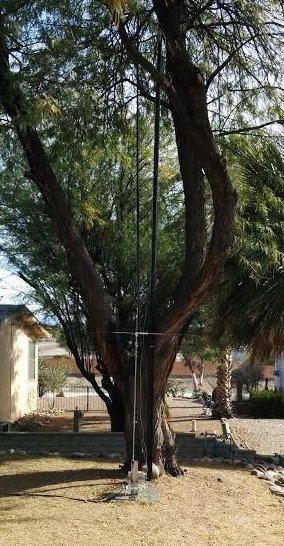
A quarter-wave vertical solves the space problem elegantly. It occupies a single point of ground, it radiates equally in all horizontal directions, and its natural pattern favors low angles, which is exactly what you want for long-distance contacts. Every new operator who reads that sentence buys a vertical, and roughly half of them are disappointed. The reason is the half of the antenna nobody mentions in the advertisement: the ground system.
A vertical is only half an antenna. The missing half is provided either by elevated radials, by a large number of on-ground radials, or by the earth itself, and the earth is a poor conductor. A quarter-wave vertical over four short radials can waste more than half of your transmitted power heating dirt. The same antenna over sixteen quarter-wave radials, or over four properly resonant elevated radials, becomes genuinely excellent. If you install a vertical, budget your effort accordingly: the radial field is the project, and the vertical element is the easy part.
End-fed half-waves and random wires
The last decade has made the end-fed half-wave enormously popular, and the appeal is obvious. One support point, one wire, a small transformer box at the feed end, and multiband operation on the harmonically related bands without a tuner. For apartment dwellers, portable operators, and anyone with exactly one tree, it is a genuinely useful design.
Be clear about the tradeoffs, though. An end-fed half-wave is fed at a high-impedance point, so it needs a 49:1 or 64:1 transformer, and that transformer has loss that rises with frequency and with mismatch. It also relies on the feedline and your station ground as a counterpoise to some degree, which means common-mode current on the coax shield is the normal state rather than the exception. Plan on a good common-mode choke behind the transformer, and expect to hear more local noise than a balanced dipole would deliver. A random-length wire with a remote tuner is the same bargain taken further: maximum flexibility, real losses, and a permanent relationship with common-mode current.
Height, and why it beats everything else
For horizontal antennas, height above ground changes the radiation pattern more dramatically than any other single variable. A dipole a tenth of a wavelength up radiates almost everything straight overhead, which is superb for regional contacts on 80 and 40 meters and nearly useless for working across an ocean. The same dipole at half a wavelength develops distinct lower-angle lobes and starts behaving like a DX antenna. On 20 meters half a wavelength is about 33 feet, which is achievable in many yards. On 80 meters it is 130 feet, which is not, and that is why low 80 meter dipoles are regional antennas and everyone stops arguing about it.
The rule to carry away is simple: get horizontal wire as high as you safely can, and if you cannot get it high, accept that you have built an excellent regional antenna and enjoy the nets and the ragchews it will bring you. Do not spend money trying to buy your way out of a height limitation. Spend it on a vertical instead, which does not care about height in the same way.
Multiband strategies without the marketing
There are four honest ways to cover multiple bands. First, put up several single-band dipoles fed from a common point, which works well and costs almost nothing but wire. Second, build a fan dipole or trap dipole, which is the same idea in a tidier package with slightly narrower bandwidth. Third, use a doublet fed with ladder line and a balanced tuner, which is the most efficient multiband solution ever devised and the least convenient to install. Fourth, use an end-fed half-wave or random wire with a transformer or remote tuner and accept the losses in exchange for simplicity.
What you should be skeptical of is any antenna advertised as covering 80 through 6 meters in eight feet of space with no radials and no tuner. Physics has not been repealed. Small antennas on low bands have narrow bandwidth, low efficiency, or both, and the ones that appear to escape this are usually burning your power in a resistive load somewhere. That does not make them useless, it makes them a compromise, and knowing which compromise you have bought is the whole point.
What to build first, honestly
If you have two supports and sixty-six feet of span, build a 40 meter dipole and feed it with good coax and a choke. It will work 40 and 15 meters directly, and with a tuner it will do useful work on several more. If you have one support, build or buy an end-fed half-wave for 40 meters, add a common-mode choke, and be aware of the noise tradeoff. If you have no supports at all, install a quarter-wave vertical for 20 meters and spend a weekend laying sixteen radials, and you will have a real DX antenna in a suburban yard.
Whichever you choose, sweep it with an analyzer before you trust it, log where the resonance actually landed, and write the numbers down. Six months later, when something changes, that record will tell you in thirty seconds whether the antenna moved or the radio did.
Every HAMSTATION tool runs entirely client-side. No accounts, no tracking, no server storage.
Open the toolkit →