Contesting Basics for Normal Humans: Your First Weekend
Radio contests look like chaos. Underneath the noise is a simple structure that anyone can learn in an afternoon and enjoy for a lifetime.
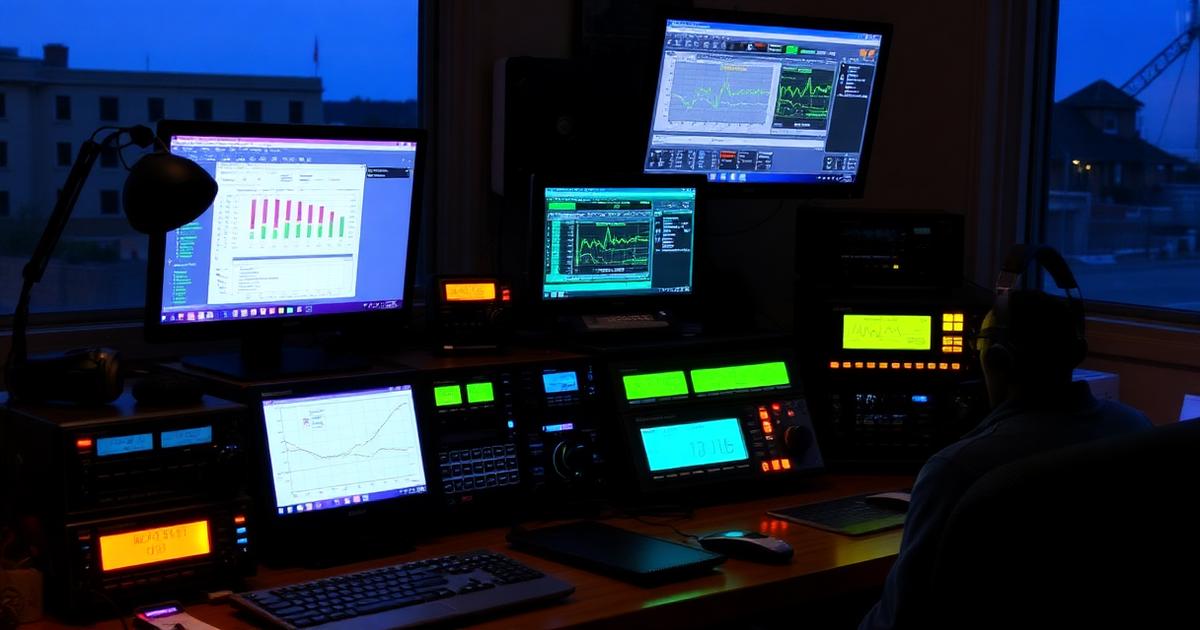
What a contest actually is
A radio contest is a scheduled window, usually a weekend, during which participants try to make as many valid exchanges as possible on the air. Each exchange is a short, structured trade of information: call signs, a signal report, and a small piece of data such as a serial number, a grid square, or a state abbreviation. The goal is to log more valid exchanges, weighted by distance or multiplier, than the other participants in your entry category.
The wall of noise you hear when you tune into a major contest is thousands of stations doing this in parallel. It sounds hostile if you have never done it. It stops sounding hostile the moment you understand the pattern, because every contact you hear follows exactly the same script.
The script, in five lines
A running station calls CQ with the contest name. A hunter calls back with their own call sign. The runner acknowledges with the hunter's call, a signal report, and the required exchange data. The hunter confirms with their own signal report and exchange. The runner says thanks and calls CQ again. The whole thing takes six to twelve seconds on CW, ten to fifteen on SSB, and about ninety seconds on FT8. Every valid QSO in every contest anywhere in the world follows this same skeleton.
Once you can predict every next word, contesting stops feeling like chaos and starts feeling like a rhythm you can settle into. Most operators go from confused first-timer to comfortable participant in a single weekend.
Choosing your first contest
The best first contests are the ones with the simplest exchanges and the broadest participation. In North America, the ARRL Sweepstakes and the November Sweepstakes CW are legendary but the exchange is famously long. Better first choices are the ARRL Field Day, the NAQP series, and the CQ Worldwide, all of which have short exchanges and lots of stations willing to work slowly with newcomers.
Do not chase the biggest DX contest for your first outing. Instead pick something regional where the pace is a little slower and the operators are patient. Field Day in June is exceptional for this because the whole point of the event is to get new operators on the air.
Two categories, two personalities
Contesters divide roughly into runners and hunters. A runner sits on one frequency, calls CQ, and lets contacts come to them. A hunter, sometimes called search-and-pounce, tunes across the band, finds stations already running, and works them one at a time. Runners score more per hour when they have a working setup. Hunters score more when the band is crowded and skill at picking a call sign out of a pileup matters.
For your first contest, hunt. You control the pace, you can skip stations that talk too fast, and you get to hear a range of operating styles before you try running yourself. Once you have five or ten contacts logged and the rhythm feels natural, park on a quiet frequency and try one CQ.
The equipment you already have is enough
The most common excuse for not entering a contest is that the station is not competitive. This is almost always wrong. Competitive means competitive within a category, and there are categories for QRP power, for single-band entries, for rookies, for classic tube radios, for anything you can plausibly define. A five-watt station on a wire antenna, entered as QRP single-band low power, is genuinely competitive against every other station in that same category.
The gear that matters most is a computer running a decent logging program, headphones that isolate you from the room, and a habit of writing every call sign down before you send it back. Everything else, from voice keyers to keyboard macros, is optimization.
The one habit that changes everything
After every contest, spend ten minutes reading your log. You will see the same three or four mistakes over and over: busted call signs, missed exchanges, moments when you called CQ into a band that was clearly dead. Each mistake, once you notice it, disappears from your next contest. Three or four events into a season, your rate has doubled and you have no memory of when it changed. Contesting rewards deliberate practice in a way that casual operating never does. That is why the same names show up on the same trophies year after year: they log their contests, they read their logs, and they get slightly better every time.
Every HAMSTATION tool runs entirely client-side. No accounts, no tracking, no server storage.
Open the toolkit →