POTA and SOTA: A Practical Guide to Activating in the Field
Park and summit activations turned portable operating into the fastest-growing corner of the hobby. Here is the kit, the technique, and the etiquette.
Why activations changed the hobby
For most of amateur radio's history, the default station was a permanent installation in a spare room. Then two award programs, Summits On The Air and Parks On The Air, quietly rearranged the culture. Suddenly the interesting operating was happening from a rock outcrop with a five-watt radio and a wire in a tree, and thousands of operators who had never carried a radio anywhere discovered that a modest portable station in a good location outperforms a compromised station at home.
The appeal is not only technical. An activation is a small, self-contained project with a clear success condition, which is exactly the kind of goal that keeps a hobby alive. You pick a location, you carry in the gear, you make the required number of contacts, and you go home having accomplished something specific. The bands do not have to cooperate for it to have been a good afternoon, and that turns out to matter more than any equipment upgrade.
POTA and SOTA are not the same game
Parks On The Air is about designated parks and public lands. You drive to the park, you may operate from anywhere within its boundary including a picnic table or your vehicle, and the requirement for a valid activation is ten contacts in a UTC day. Because access is easy, POTA is the friendlier of the two for a first attempt and for operators carrying heavier gear or working from a wheelchair-accessible site.
Summits On The Air is about mountain summits, and the rules are deliberately stricter. The station must be entirely portable, powered by something you carried, and operated within a defined vertical distance of the summit, and motor vehicles may not be used to reach the operating position. The required number of contacts for the activator's points is four. SOTA is harder logistically and correspondingly more rewarding in points and satisfaction, and the vertical-distance rule means you cannot simply park at a scenic overlook and call it a summit.
Both programs run public spotting systems where activators announce their frequency and chasers come looking. That spotting culture is the reason a five-watt station can run a queue of twenty contacts in half an hour, which would be an unusual result from an unannounced call on a quiet band.
The kit, weighed
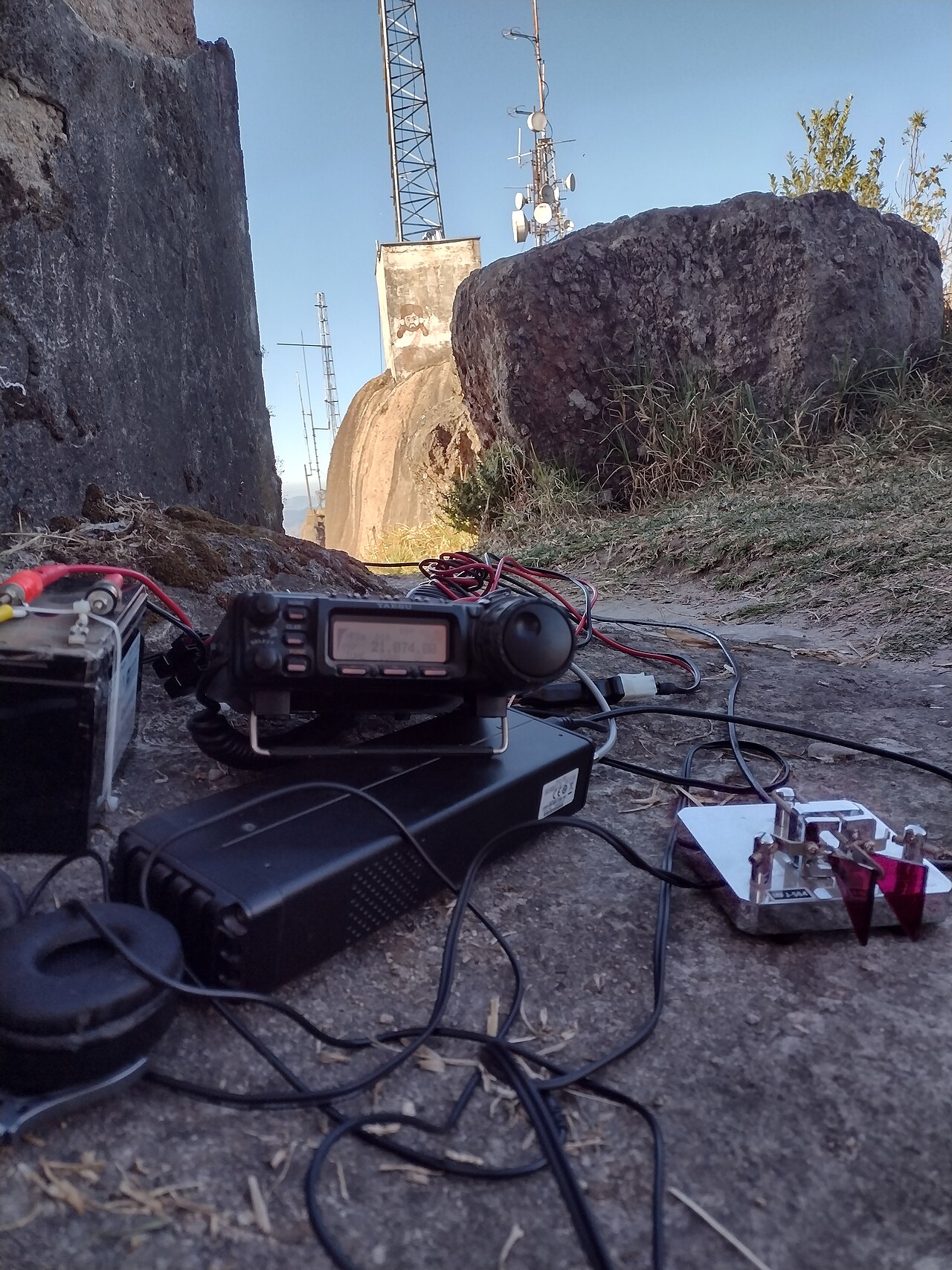
A complete field station fits in a small backpack. A five to ten watt portable transceiver, a lightweight antenna, a battery in the 3 to 6 amp-hour class, a short coax run, a paddle or microphone, a notebook and pencil, and a phone for spotting. Total weight lands between four and nine pounds depending on how disciplined you are about the antenna support.
The antenna is where the real decisions happen. An end-fed half-wave for 40 and 20 meters thrown over a branch is the classic answer: light, quick, and effective. A telescoping carbon or fiberglass mast with a vertical wire and two or three radials is heavier but works where there are no trees and gives better low-angle performance for distant contacts. A linked dipole, where you unclip sections to change bands, is the purist's choice with the best efficiency and the most fiddling. Any of the three will make the contacts. What matters is that you have practiced deploying it in the yard before you try it on a windy ridge with cold hands.
For power, the arithmetic from a five-watt radio is friendly: transmit current is typically under two amps, so a 3 amp-hour LiFePO4 pack supports a long session with margin. Run your own numbers through the HAMSTATION battery life calculator if you plan to use a hundred-watt radio in the field, because the answer changes dramatically.
Calling CQ so that people answer
Find a clear frequency, listen for at least thirty seconds, ask whether the frequency is in use, then spot yourself on the program's website or app with your call sign, the reference number, the frequency, and the mode. The spot is what turns your call into a queue. Without it you are an unknown weak signal; with it you are a wanted station and chasers will be tuned in before you finish your first call.
Call in a rhythm. Give your call sign, the reference, and the fact that you are portable, then listen. When answers come, work them briefly: exchange call signs and signal reports, confirm, and move on. Chasers understand that an activator has limited battery and daylight, and nobody is offended by an efficient contact. If the queue dries up, spot yourself again on a different band rather than calling into silence for twenty minutes.
Logging in the field without losing contacts
Paper and pencil work in any weather and never run out of battery, and a great many experienced activators still use them. Write UTC time, call sign, band, mode, and signal reports, and transcribe into your logging software the same evening while your memory can still repair an unclear entry. Phone and tablet apps designed for activations are excellent and considerably faster, provided you have tested the app before you rely on it and have a paper backup for the moment the screen becomes unreadable in bright sun.
Whatever you use, capture times in UTC and be accurate to within a couple of minutes. Chasers' logs are matched against yours, and a systematically wrong clock creates work for everyone. The HAMSTATION logbook tool will hold entries locally in your browser and export clean CSV when you get home, which is a reasonable middle path if you would rather not install anything.
Rules, permits, and being a good guest
Public land is not permission-free land. Some parks require a permit for any organized activity, some prohibit anything driven into the ground, and some have quiet hours or seasonal closures for wildlife. Read the specific site's rules before you go, and default to leaving no trace: no holes, no cut vegetation, nothing tied so tightly it damages bark, and everything you carried in carried out.
Be equally thoughtful about the humans. A picnic table in a busy park is not the place for a sprawling antenna farm across a footpath. Set up off to the side, keep guy lines visible, and be ready to explain what you are doing in one friendly sentence, because someone will ask. Those conversations recruit more new operators than any club open house.
Your first activation, step by step
Pick a park close to home, ideally one you have visited before, and choose a weekday afternoon when the site is quiet. Deploy your antenna in the backyard the day before and time yourself. On the day, arrive with two hours of daylight in hand, set up without hurrying, and start on 20 meters if it is daytime or 40 meters near dusk. Spot yourself, call for fifteen minutes, then change bands if the answers stop.
You will probably reach the required contact count in under half an hour, and you will almost certainly make one mistake you will not repeat: a forgotten adapter, a mast section that binds, a battery lead too short. Write the mistake down next to the log. Three activations later you will have a kit that goes from pack to on-air in eight minutes, and the whole exercise will have become the most reliable fun in the hobby.
Every HAMSTATION tool runs entirely client-side. No accounts, no tracking, no server storage.
Open the toolkit →