Powering Your Station: Batteries, Solar, and Honest Power Budgets
Most portable stations fail on power, not on radio. Here is how to size a battery, budget a weekend, and stop guessing at duty cycle.
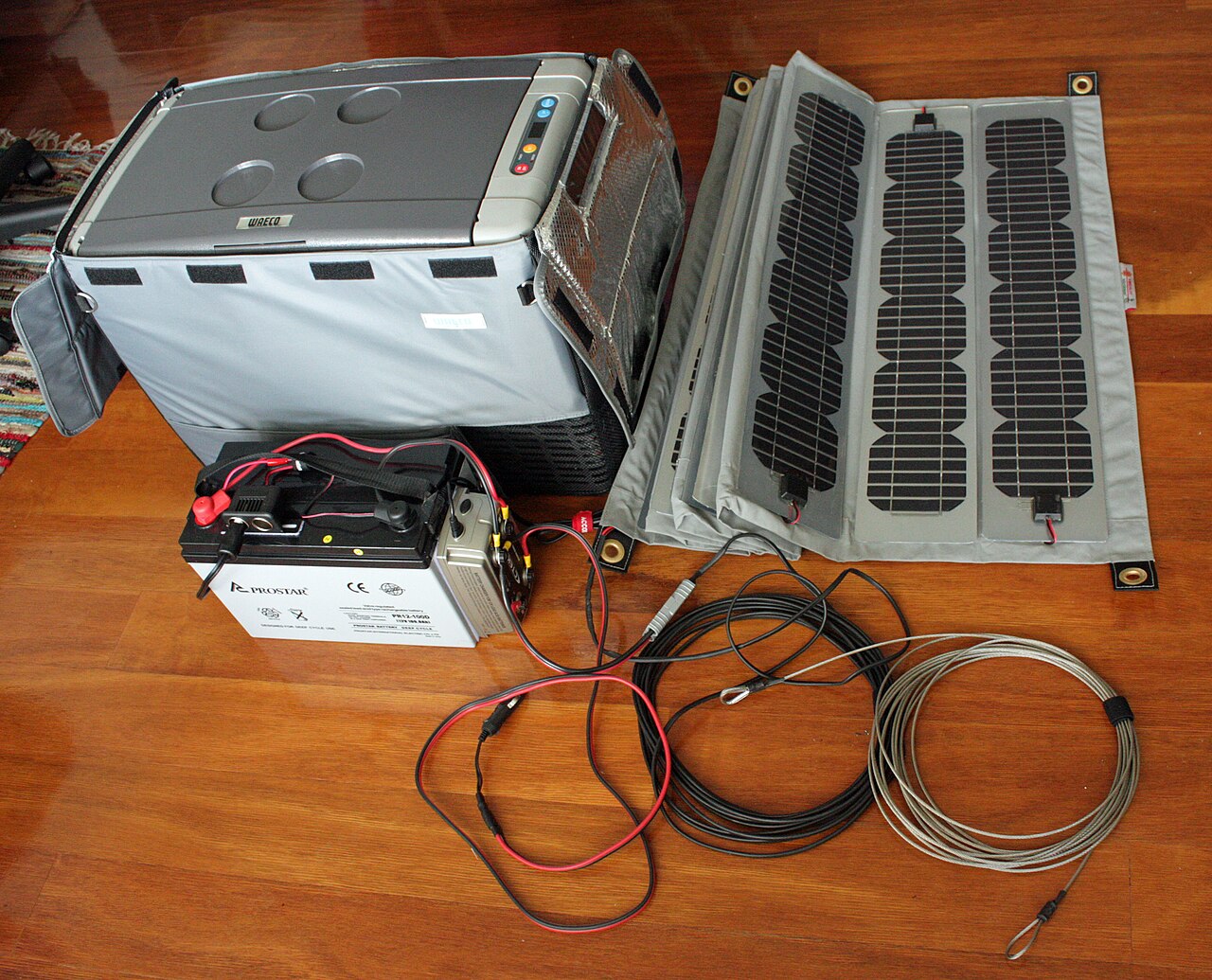
Power is the constraint that decides everything
Ask a group of operators why a field operation ended early and the answer is almost never the radio. It is that the battery died at hour six of a planned twelve, or the power supply hummed so badly on receive that nobody could hear anything, or a fuse that should have existed did not and a two-dollar mistake cost a hundred-dollar radio. Power is where amateur radio projects quietly fail, and it is also the easiest part of the station to get right, because unlike propagation it obeys arithmetic you can do in advance.
The goal of this article is a number: how many amp-hours you actually need for the operating you actually plan to do. Everything else, the chemistry choice, the solar panel, the wiring gauge, follows from that number. Guessing produces either a dead station or a battery you were unhappy to carry.
Duty cycle, the number that actually matters
A hundred-watt HF transceiver draws roughly twenty amps at thirteen volts while transmitting and one to two amps while receiving. If you naively size a battery for twenty amps continuous, you will carry far more weight than any operating session needs, because you do not transmit continuously. In a normal SSB conversation you transmit perhaps forty percent of the time you are in a QSO, and your voice peaks mean the average current during transmit is well below the peak. In casual operating with listening, tuning, and logging, the overall transmit fraction often lands closer to fifteen or twenty percent.
Digital modes flip this picture. FT8 transmits a full-power, constant-envelope signal for about thirteen seconds out of every fifteen-second slot, and it does that continuously for hours. A digital session is close to a fifty percent duty cycle at full transmit current, which is three or four times the average draw of a chatty SSB afternoon. CW sits in between, closer to SSB than to FT8 for most operators.
The HAMSTATION battery life calculator exists precisely for this arithmetic. Feed it your transmit current, receive current, and honest transmit percentage, and it will tell you how long a given battery lasts and how large a battery a given session needs. Do that before you buy anything.
Lead-acid, AGM, and LiFePO4 compared honestly
Flooded lead-acid is cheap, heavy, tolerant of abuse in some ways and utterly intolerant in others, and it must stay upright and ventilated. It is a reasonable choice for a fixed backup bank in a garage and a poor choice for anything you carry.
Sealed AGM is the traditional portable answer: sealed, orientation-tolerant, widely available, and inexpensive. Its disadvantages are weight and depth of discharge. Take an AGM below fifty percent regularly and its life collapses, which means a nominal 35 amp-hour AGM is really a 17 amp-hour battery for planning purposes, and it weighs around twenty-five pounds.
LiFePO4 has become the default for portable amateur use, and the reasons are compelling. It delivers eighty to ninety percent of its rated capacity without complaint, holds voltage nearly flat until it is nearly empty, weighs roughly a third of an equivalent AGM, and tolerates two thousand or more cycles. It costs more up front and needs a charger that understands its chemistry, and its built-in protection board will cut off abruptly rather than fading, which is a behavior to plan around rather than fear. For a portable HF station, a 20 to 30 amp-hour LiFePO4 pack is the sweet spot that covers almost every realistic outing.
Sizing a battery for a real weekend
Work the example. Suppose you plan two four-hour SSB sessions, with a transmit fraction of twenty percent, transmit current of eighteen amps, and receive current of one and a half amps. Each hour costs you roughly 0.2 times 18 plus 0.8 times 1.5, which is about 4.8 amp-hours. Eight hours of operating is therefore about 38 amp-hours of energy delivered.
For LiFePO4 at eighty-five percent usable depth, you need about 45 amp-hours of nominal capacity, or two 20 to 25 amp-hour packs, or one larger pack plus a recharge between sessions. For AGM at fifty percent usable depth, you would need 76 amp-hours nominal, which is over fifty pounds of battery. That single calculation is why the field-portable community switched chemistry almost overnight.
If your weekend is a digital operation instead, redo the arithmetic with a fifty percent transmit fraction and watch the requirement triple. There is no shortcut here, only the calculator and your honest estimate of how you actually operate.
Solar without the wishful thinking
A solar panel is rated at its output under laboratory illumination, pointed directly at the sun. In the field, at a real angle, in real haze, through a real charge controller, plan on sixty to seventy percent of the rating for the hours around midday and much less at the edges of the day. A 100 watt panel realistically returns something like 300 to 400 watt-hours on a clear summer day at mid latitudes, which is roughly 25 to 30 amp-hours at 13 volts. That is enough to run the SSB station above indefinitely and not quite enough to keep a full-time FT8 station fed.
Use an MPPT controller rather than the cheapest PWM unit if the panel voltage is much higher than the battery voltage, and check the controller for RF noise before you trust it. Some inexpensive controllers are appalling noise generators; a ferrite choke on the panel leads and on the battery leads is a cheap insurance policy. Never connect a panel directly to a battery without a controller.
Mains supplies and the noise tax
For a home station, a switching power supply designed for amateur service is compact, efficient, and generally quiet enough. A cheap generic switcher is a different animal and can single-handedly ruin the low bands for your whole neighborhood. If you are chasing a mysterious noise floor, unplug the power supply and run the radio from a battery for five minutes. That one test settles the question immediately.
Linear supplies are heavy, hot, and RF-quiet by nature. Many operators keep a linear supply for the HF rig and a switcher for accessories, which is a sensible compromise. Whatever you choose, size it for at least twenty-five amps continuous for a hundred-watt radio, because a supply operating at the edge of its rating sags on voice peaks and produces flat-topped, distorted transmit audio.
Wiring, fusing, and the part that is about safety
Use the largest practical conductor for the main power run, keep it short, and fuse both the positive and negative leads close to the battery. A lead-acid or lithium pack can deliver hundreds of amps into a short circuit, enough to set a wire on fire in seconds, and the fuse exists to protect the wiring rather than the radio. Use the fuse rating the radio manual specifies, not the largest one that fits the holder.
Standardize on one connector family for the whole station. Whichever you choose, use it everywhere, so that any battery can power any device without an adapter chain. Keep a small kit with spare fuses, a spare connector pair, and a multimeter in the same bag as the battery. A crimped connector that has worked loose is the most common field failure in amateur radio, and it takes two minutes to fix when you have the parts and ends the day when you do not.
Every HAMSTATION tool runs entirely client-side. No accounts, no tracking, no server storage.
Open the toolkit →