SSB, AM, FM, and CW: Choosing the Right Mode for the Job
Modes are engineering tradeoffs between bandwidth, power efficiency, and audio quality. Understanding the tradeoff tells you which one to reach for.
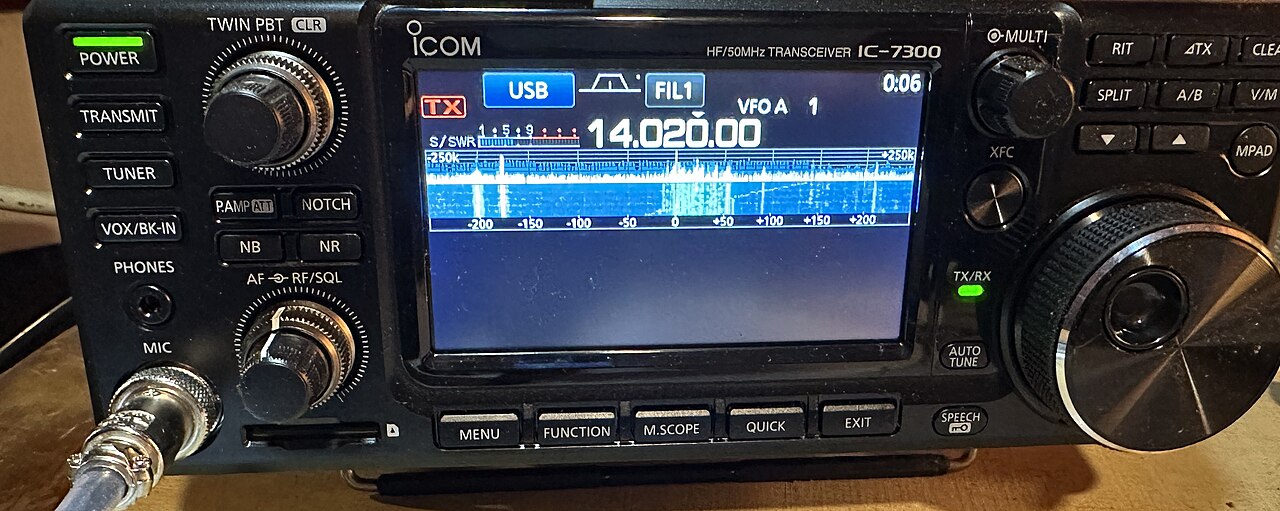
Modes are tradeoffs, not preferences
Newcomers often assume that mode choice in amateur radio is a matter of taste, like choosing a favorite instrument. There is some truth in that, but underneath the culture sits a set of hard engineering tradeoffs. Every mode spends bandwidth, transmitter power, and equipment complexity in a different proportion, and each of those choices buys something specific: intelligibility in noise, audio fidelity, resistance to fading, or simply the ability to be built with 1920s technology.
Once you can see the tradeoffs, mode selection becomes obvious rather than tribal. A weak signal on a marginal path wants a narrow mode. A local conversation with good signal margin can afford a wide one. An emergency net wants whatever the largest number of available radios can use. That is the whole decision, and the rest is history and habit.
AM, the original and the least efficient
Amplitude modulation transmits a carrier plus two identical sidebands, each carrying the same information. It occupies roughly six kilohertz for speech, and in a normal transmission most of the power goes into the carrier, which carries no information at all. That is the definition of inefficiency: two thirds or more of your output spent on a signal that conveys nothing, and double the necessary bandwidth for the part that does.
AM survives on the amateur bands anyway, for two good reasons. It sounds superb when conditions allow, because the wide bandwidth carries real audio fidelity, and it requires the simplest possible receiver, which is why it was the standard for half a century. The AM community on 75 and 40 meters maintains beautifully restored vintage equipment and is one of the most technically knowledgeable corners of the hobby. Just do not expect to work a weak station across an ocean with it.
SSB, the workhorse of HF voice
Single sideband removes the carrier and one of the two redundant sidebands, leaving about 2.4 to 2.8 kilohertz of bandwidth carrying all of the information and all of the power. Compared with AM at the same peak output, that is roughly a factor of eight improvement in useful signal at the receiver, which is the reason SSB displaced AM for long-distance voice work in the 1950s and never gave the ground back.
The cost is complexity and a peculiar requirement: the receiver has to reinsert the missing carrier at exactly the right frequency, which is why an SSB signal tuned even fifty hertz off sounds like a person talking underwater. There is also a convention worth memorizing because it confuses every newcomer once: below 10 MHz amateurs use lower sideband, and above 10 MHz they use upper sideband. There is no physical reason for the split; it is pure convention, and following it is the difference between being understood and being ignored.
FM, and why VHF sounds like a telephone
Frequency modulation encodes information in frequency deviation rather than amplitude, and it has one dramatic property: above a certain signal threshold, the noise essentially disappears. That is the capture effect, and it is why a VHF repeater contact sounds like a telephone call while an HF SSB contact sounds like a radio. The cost is bandwidth, typically twelve to sixteen kilohertz per channel, which is generous on the crowded HF bands and irrelevant on VHF and UHF where spectrum is comparatively plentiful.
FM also has a hard failure mode. Below the capture threshold the signal does not fade gracefully into noise the way SSB does; it collapses into a rush of static and becomes unusable within a decibel or two. This is why an operator walking away from a repeater goes from perfect audio to nothing over a short distance, and why weak-signal work on VHF is done in SSB or CW rather than FM.
CW, the mode that refuses to die
Continuous wave keying is simply switching a carrier on and off, and it is the oldest mode in radio. It needs about 100 to 200 hertz of bandwidth, which is more than an order of magnitude narrower than SSB. Because receiver noise power is proportional to bandwidth, narrowing the receiver from 2.4 kilohertz to 200 hertz improves the signal-to-noise ratio by roughly eleven decibels for the same transmitted power. That is the entire reason CW outperforms voice on weak paths, and it is why the mode survived the removal of the code test from every licensing regime in the world.
There is a second advantage that matters in practice. A human brain trained on morse code can pull a signal out of noise well below the level at which speech becomes unintelligible, and it can do so through the kind of rapid fading that destroys voice communication. Between the bandwidth advantage and the human decoder, a five-watt CW station is roughly comparable to a hundred-watt SSB station on the same antenna, which is a remarkable return on a skill that takes a few months to learn.
Digital modes and where they fit
Modern digital modes take the CW principle further by moving the decoding into software that is more patient than any human. FT8 occupies about fifty hertz and decodes reliably more than twenty decibels below the noise floor in a 2.5 kilohertz bandwidth, which is why it works when nothing else does. The price is that the exchange is rigidly structured and carries almost no information beyond call signs, grid squares, and reports.
That tradeoff defines the honest place for digital modes. They are unbeatable for confirming that a path exists, for chasing grid squares and countries, and for making contacts on a dead band with a compromised antenna. They are not conversation. Operators who want to talk to people use SSB or CW, and operators who want to work everything use whichever mode the propagation allows on the day.
Choosing a mode for the job
For a local conversation through a repeater, use FM, because that is what everyone else has programmed and the audio quality is excellent. For regional daytime work on 40 meters with strong signals, use SSB and enjoy the conversation. For a weak signal, a marginal opening, a low-power station, or a noisy environment, use CW if you can and a digital mode if you cannot. For a QRP portable station where every decibel matters, use CW, because the mode advantage is worth more than any equipment you could carry instead.
One last practical note: the band plan allocates different segments to different mode groups, and operating a wide mode inside a narrow-mode segment is the fastest way to annoy an entire band. Check the HAMSTATION band plan reference before you transmit somewhere unfamiliar, particularly on bands you rarely use, and particularly when travelling to a country with a different allocation.
Every HAMSTATION tool runs entirely client-side. No accounts, no tracking, no server storage.
Open the toolkit →